
Two kinds of squirrel
California has native tree squirrels and introduced ones, and most people meet only the introduced kind without realizing it.
The natives are the Western Gray Squirrel and the Douglas Squirrel (plus the rarely-seen Northern Flying Squirrel) — forest animals that were here long before the cities. The newcomers are the Eastern Gray Squirrel and the Fox Squirrel, brought from the east of the Mississippi ( from as far ranging places as Minnesota, Louisiana and the Eastern seaboard), and are now common in California's populated areas.
Eastern Gray and Western Gray are different species
And to clear up the most common mix-up first: the Eastern Gray and Western Gray are different species — not two regional names for the same animal. The squirrel on a city lawn is almost always the introduced one. The natives are out in the trees.
Where you actually meet them
Sort the squirrels by where you're most likely to run into one — from deep wild forest to the middle of the city — and the whole story shows up in a single picture.
Approximate habitat association. The shaded areas show where each species is most often encountered, not the limits of its range.
For actual geographic distribution, see the Range Maps. This chart shows where people are most likely to encounter each species, not where each species can occur.
The natives cluster at the wild end. The newcomers fill the human end. And the telling part is the gap in the middle: California's native squirrels avoid the cities. That, in one image, is the difference between a forest specialist and an urban generalist.
The squirrels at a glance
| Squirrel | Origin | Around people | Where you'll meet it | At a glance |
|---|---|---|---|---|
| Western Gray | Native | Shy; wary even after exposure | Oak woodland & conifer forest | Silver-gray, white belly, huge feathery tail |
| Douglas | Native | Vocal, curious-cautious; scolds from nearby and can grow trusting where it lives near people | Conifer forest (Sierra, north coast) | Small, rusty belly, very loud |
| Northern Flying | Native | Nocturnal; almost never seen | Forest canopy | Glides; big eyes; rarely encountered |
| Eastern Gray | Introduced | Bold; at ease with people | Bay Area & Sacramento cities | Gray; the classic "park squirrel" |
| Fox | Introduced | Bold; at ease with people | LA basin, Central Valley & Bay Area suburbs, campuses, city edges | Largest; rusty-orange tones |
The shy natives
The Western Gray Squirrel is a forest specialist. It needs large, connected stretches of tree canopy, and it stays shy of people — it will slip up the far side of a trunk before you've quite registered it. Even where it could learn to take a handout, it doesn't. It never wanted the city.
So it isn't that the native lost some contest for the city. We removed the thing it depends on. As development broke the connected woodland into pieces, the canopy that sustains the Western Gray simply thinned out of the places people live. Its retreat has several contributing causes, weighted differently from place to place: habitat fragmentation, canopy loss, disease — including notoedric mange — and possibly interactions with the introduced squirrels. How much each matters is genuinely debated, and it would be wrong to say the newcomers simply drove the natives out.
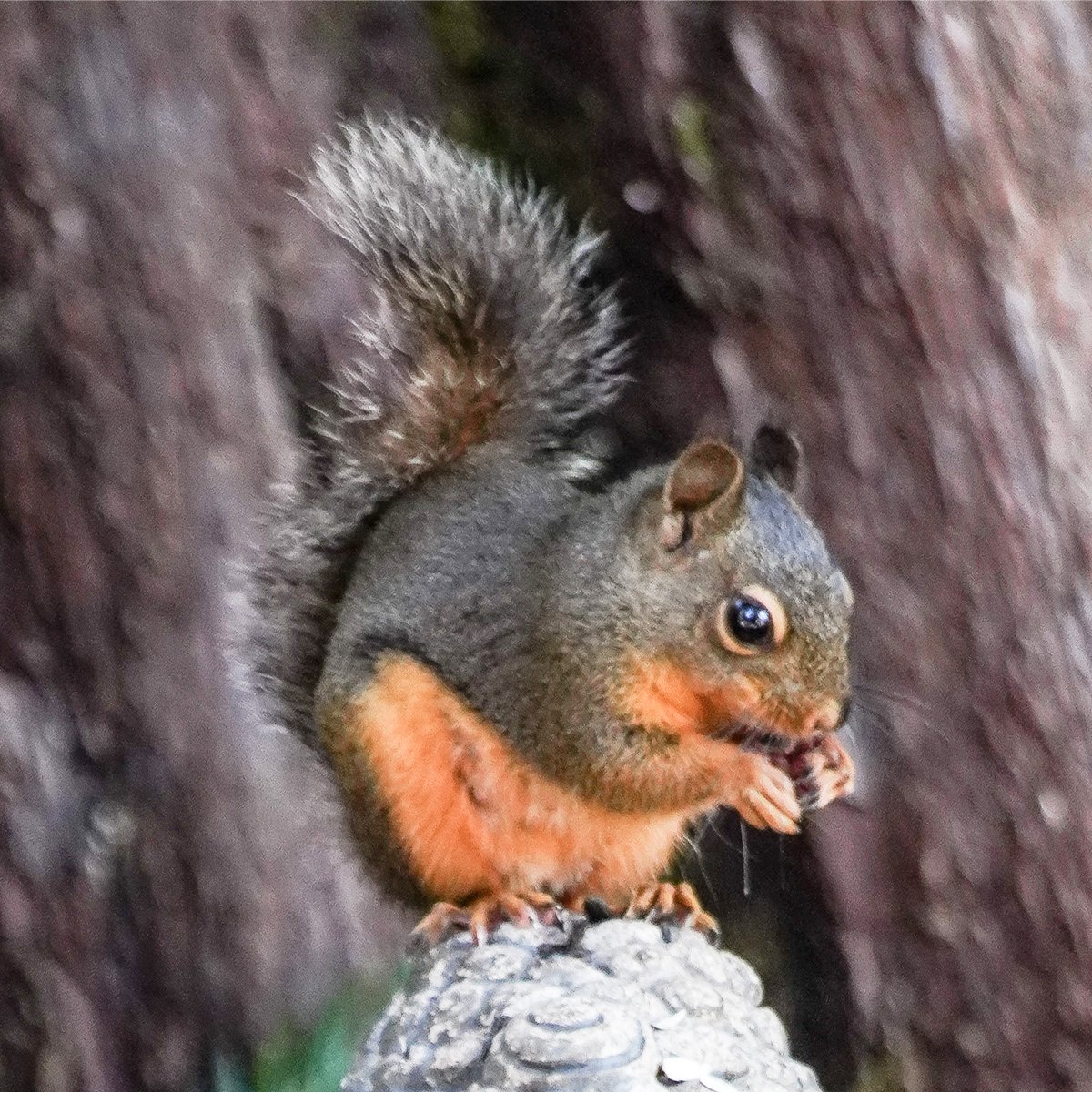
The Douglas Squirrel complicates the easy picture in a useful way. It is not a shy, vanish-on-sight animal: it's loud, fast, and territorial, and it will scold you from a nearby branch rather than disappear. Where Douglas squirrels live around people in the forest — campgrounds, cabins, trailheads — they can grow noticeably trusting. In how it handles people, the Douglas sits in a middle ground between the wary Western Gray and the bold newcomers. But that boldness is a temperament, not an address: the Douglas is tied to conifer forest and never colonizes suburbs or parks. It's the clearest proof that being unafraid of people is not the same as being a city animal.

The bold newcomers
The Eastern Gray and the Fox Squirrel were known to be human-friendly and easily accustomed to a human-built landscape.
But adaptability is only half of it. People wanted them here. Towns and campuses welcomed squirrels on purpose. They became live actors in the parks. We humans wanted a small, lively piece of nature you could watch from a bench. The newcomers are the far-western end of a deliberate, century-long effort to put nature back into American cities. (That whole story is told in How Squirrels Came West.)


A living bridge to the wild
Here's one way to understand why the bold squirrels took hold so completely: a city is short on wildness, and the squirrel offered a living bridge to it — close, ground-level, and willing to come to your hand in a way most wild animals never will.
Why a squirrel and not a bird? The trees already had birds — but a bird keeps its distance. The squirrel meets you halfway. (We may also simply recognize something of ourselves in a fellow mammal; that kinship is its own story, told on the evolution page.) There's an irony in it, too: in the early backlash against city squirrels, those very birds were turned against them — squirrels were accused, often unfairly, of robbing songbird nests. That turn is part of the larger history.
Why the difference matters
Knowing which squirrel you're looking at changes the question from "is this the right squirrel or the wrong one?" to something more useful: which animal is this, and what does it need?
The natives need forest and connected canopy. The newcomers are here to stay and thriving. They are not the same animal living two lives — they are different species with different needs, and good stewardship starts with telling them apart.
Common mix-ups
"Black squirrels are a separate species."
No — they're almost always melanistic Eastern Grays. Same species, different coat.
"White squirrels are a separate species."
No — usually leucistic individuals (white coat, dark eyes). True albinos are far rarer.
"They're all squirrels, so they interbreed."
No — Eastern Gray and Western Gray are separate species. "Squirrel" is a common name, not a breeding group.
"Color tells you the species."
Not reliably. Structure, tail, belly, size, range, and behavior together matter far more than color alone.