
A field guide to common questions
Squirrels are familiar animals with surprisingly complicated stories.
This page is a growing collection of questions about their history, identity, behavior, and the rules that shape how people live alongside them in California.
Choose a subject below, or read from the beginning.
01
Origins and identity
How introduced populations arrived, why some squirrels are black, and what a scientific name can tell us.
California history
Why did people introduce squirrels into California?
California’s introductions were the western chapter of a larger American experiment in bringing wildlife into cities:
- Squirrels were not originally ordinary city wildlife. Nineteenth-century cities had few large parks or mature, connected trees, and woodland squirrels were rarely seen downtown.
- People wanted some visible nature back. As cities grew denser, machines replaced much animal labor, and dairies and slaughter yards moved toward the edges, residents planted trees, built parks, and deliberately released squirrels for companionship and civic beauty.
- Just releasing squirrels into cities was not enough. Some early colonies did not survive. Squirrels became lasting city residents only after large parks, street trees, leafy neighborhoods, feeding, and nest boxes gave them places to live and routes through the city.
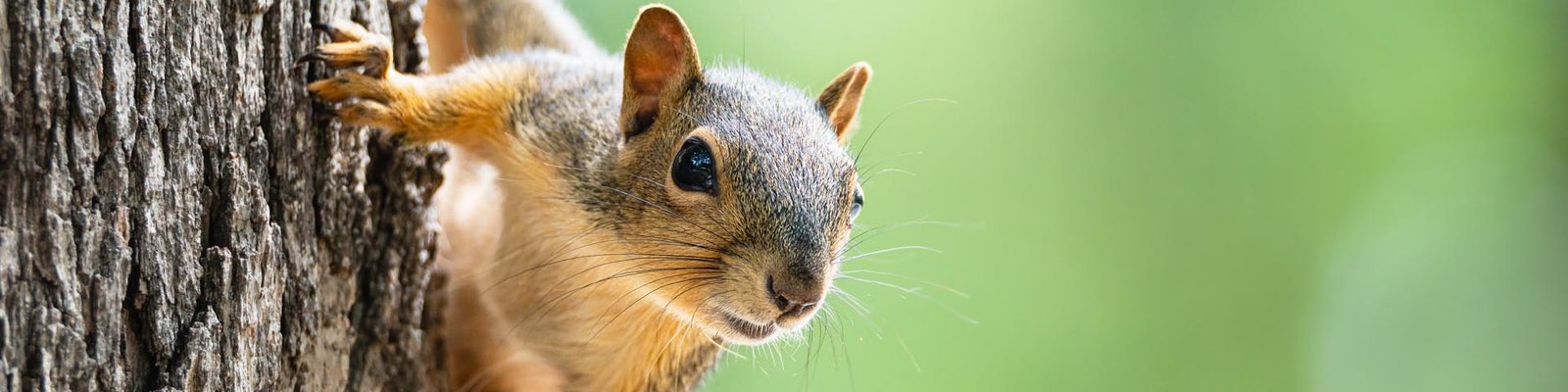
- That urban-squirrel project eventually reached California. Eastern Gray Squirrels were brought to Golden Gate Park, the Stanford campus and other campuses and wealthy estates. It was prestigious to have the new squirrels. The Fox Squirrels came for a different reason. Around 1904, Civil War and Spanish-American War veterans at the Sawtelle Veterans Home in West Los Angeles are believed to have brought Fox Squirrels as pets.
- The result was more complicated than the introductions themselves. Introduced squirrels became familiar residents of parks and neighborhoods, while California’s native tree squirrels remained closely tied to forests and oak woodlands.
Read How Squirrels Came West — about a 12-minute read.
Color and genetics
Black squirrels and Eastern Grays
Are black squirrels a different species?
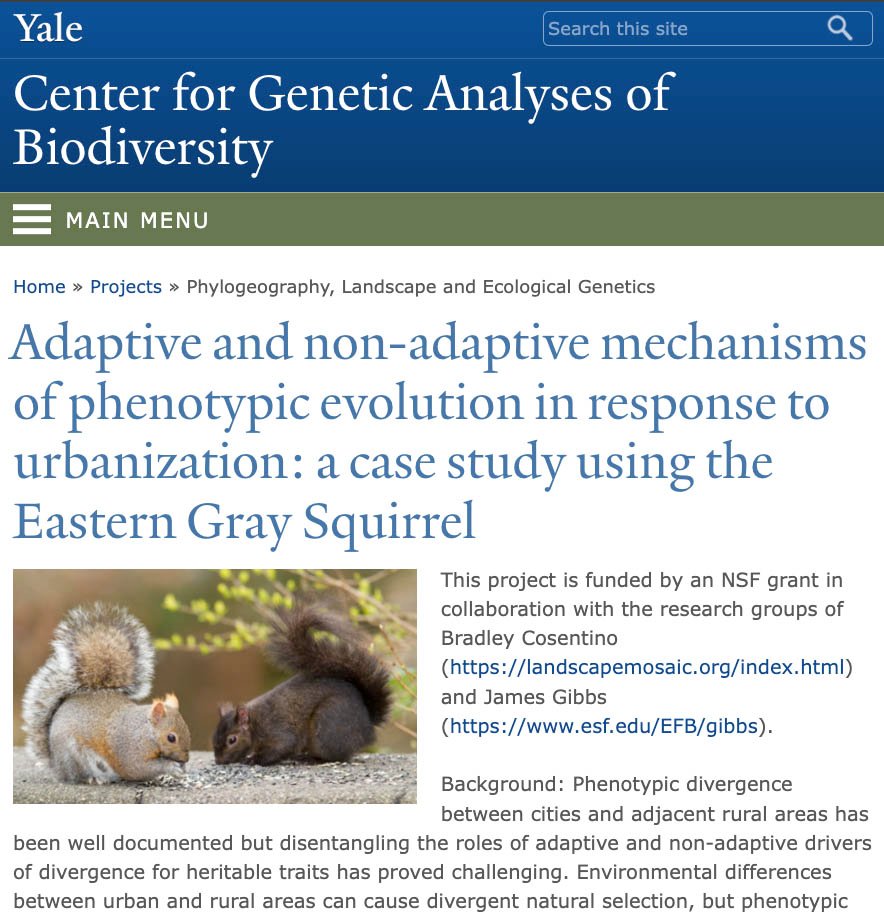
A black Eastern Gray Squirrel is not a separate species. It is a melanistic color morph of the Eastern Gray Squirrel (Sciurus carolinensis). A 24-base-pair deletion in the MC1R gene is strongly associated with the dark coat. BMC Evolutionary Biology (2019).
Why do cities have more black squirrels?
Black morphs are more common in some cities, but the pattern is not universal. In and around Syracuse, New York, black squirrels became less common from the city center toward rural woodlands. In the same study, black and gray squirrels had similar survival in the city, while black squirrels had lower survival in rural woods. The researchers concluded that selection favored gray coats in the rural sites, while selection was more relaxed in the city. Read the open-access 2023 study.
What’s the genetic change?
The MC1RΔ24 allele is associated with brown-black and black coats. A 2019 genetic study concluded that the allele most likely entered Eastern Gray Squirrels through past interbreeding with Eastern Fox Squirrels, while noting that other explanations could not be completely ruled out. Read the open-access genetics study.
Does carolinensis have anything to do with the Carolinas?
Yes. Sciurus carolinensis is the scientific name for the Eastern Gray Squirrel, and carolinensis means “of Carolina.” The species was named by Johann Friedrich Gmelin in 1788; its recorded type locality is simply “Carolina.”
02
Kinds of squirrels
Tree squirrels, ground squirrels, chipmunks, and flying squirrels all belong to the squirrel family, but they differ in the ways they live their lives.
A California comparison
Tree squirrels, ground squirrels, and chipmunks
Ground squirrel species
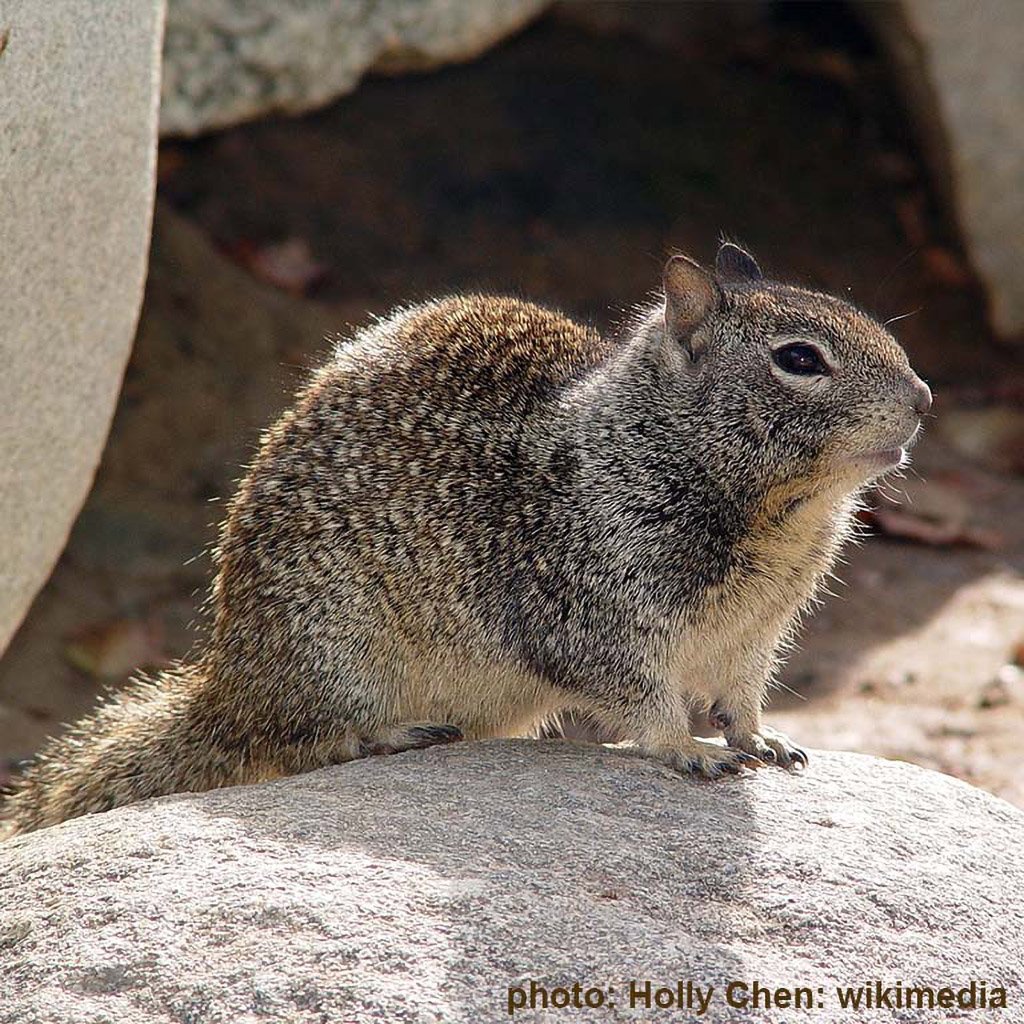
CDFW describes the California Ground Squirrel as the state’s most commonly seen ground squirrel. California has nine ground-squirrel species in the CDFW CWHR inventory: California, White-Tailed Antelope, Piute, Belding’s, Rock, Round-Tailed, Golden-Mantled, Mohave, and Nelson’s Antelope Ground Squirrels. Nelson’s is also called the San Joaquin Antelope Squirrel. The Mohave Ground Squirrel and Nelson’s/San Joaquin Antelope Ground Squirrel are both listed as threatened under California law.
Chipmunk species
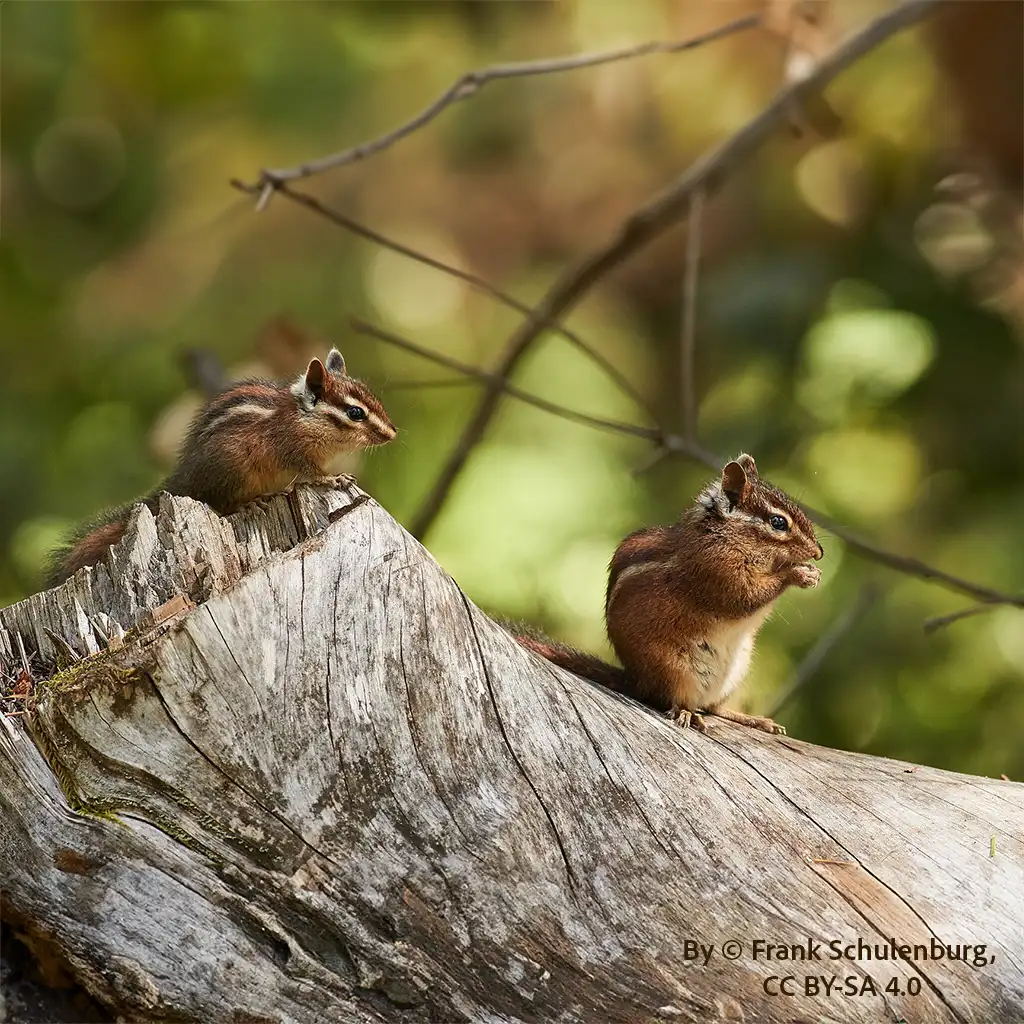
California has numerous native chipmunks in the genus Neotamias, often associated with particular regions, elevations, or habitats. The Sonoma Chipmunk, for example, lives in northwestern California. CDFW’s California Natural Diversity Database (CNDDB) tracks ten members of the squirrel family. Four of them are chipmunks: the Alpine Chipmunk and three subspecies known as the Kingston Mountain, Mount Pinos, and Lodgepole Chipmunks. See the full CDFW list.
How do tree squirrels differ from ground squirrels and chipmunks?
- Shelter: Tree squirrels usually rest and rear young in tree cavities or leaf and branch nests. Ground squirrels use burrows. Chipmunks often use burrows, rock crevices, or sheltered cavities.
- Escape: Tree squirrels usually head upward when alarmed. Ground squirrels generally retreat toward burrows. Chipmunks can climb, but often vanish into burrows, crevices, or dense cover.
- Cheek pouches: Ground squirrels and chipmunks both have cheek pouches for carrying food. Tree squirrels do not.
- Appearance: Tree squirrels usually have fuller tails. Chipmunks have stripes on the head and back; ground-squirrel markings and tail shapes vary by species.
These are useful field clues, not absolute rules. CDFW squirrel overview and UC IPM tree-squirrel guide.
A close branch of the family
What about flying squirrels?
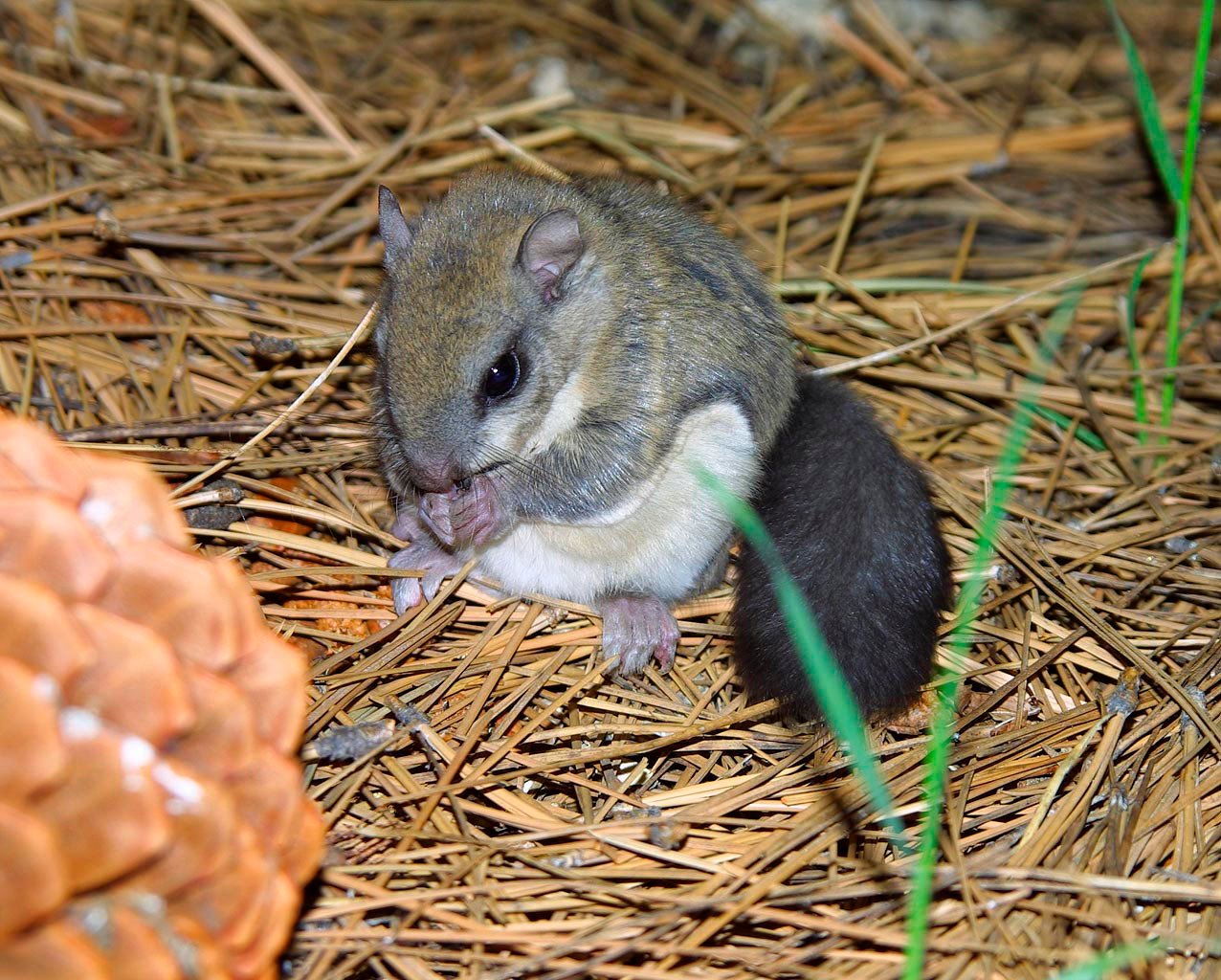
Flying squirrels share the subfamily Sciurinae with familiar tree squirrels. Ground squirrels, chipmunks, and marmots belong to a different subfamily, Xerinae. California’s flying squirrels are now classified as Humboldt’s Flying Squirrel (Glaucomys oregonensis), a species recognized in 2017 after genetic research separated the Pacific coastal lineage from the Northern Flying Squirrel.
- Activity: Humboldt’s Flying Squirrels are nocturnal.
- Gliding: A skin membrane called the patagium stretches between the wrists and ankles. The broad, flattened tail helps with control in the air.
- California range: The species extends along the Pacific Coast into southern California. The San Bernardino Flying Squirrel is a southern California subspecies, G. o. californicus.
What is a tree squirrel?
“Tree squirrel” is a useful ecological label, not one perfectly separate branch of the squirrel family. It generally describes squirrels that spend much of their lives in trees and shelter or rear young in tree cavities or leaf nests.
Ground squirrels generally shelter and rear young in burrows, although some can climb well. Chipmunks also commonly use burrows, crevices, and other sheltered spaces; they can climb but are not classified as tree squirrels.
Where a squirrel retreats when alarmed is a useful clue, but it is not a perfect identification rule. Shape, markings, location, and behavior should be considered together.
03
Behavior and biology
Questions about seasonal activity and interactions among squirrel species.
Do squirrels hibernate?
California’s Western Gray, Douglas, Eastern Gray, and Eastern Fox Squirrels do not hibernate; they remain active year-round. Some ground squirrels do hibernate, and the changes their bodies undergo are scientifically remarkable.
At the University of Wisconsin Oshkosh, researchers developed a captive breeding program for 13-lined ground squirrels that reliably hibernate. Hibernation lets scientists examine how a mammal survives dramatic changes in body temperature, heart rate, and metabolism, along with physiological stresses relevant to human health. The colony supports research involving cancer, heart disease, neurological conditions, and spaceflight, including work aimed at improving astronaut health and preparing animals for spaceflight research.
UC IPM: California tree squirrels remain active year-round
13-lined-ground-squirrel hibernation research at UW Oshkosh
Which squirrel species is the most dominant?
There is no universal hierarchy among California’s squirrels. Research on introduced Eastern Fox Squirrels and native Western Gray Squirrels in Southern California shows that the outcome varies by habitat.
A 2012 study describes three local patterns: Fox Squirrels have replaced Western Grays in some habitats, the two species coexist in others, and Western Grays persist without Fox Squirrels in still other nearby habitats even though Fox Squirrels have occupied adjacent habitat for about 30 years.
The 2009 paper documents a particularly strong replacement case at Cal Poly Pomona. After Fox Squirrels were first recorded on campus in 2005, Western Grays were virtually eliminated there in less than four years. The authors wrote that this result supports, but does not confirm, competitive exclusion and that more research would be needed to determine how Fox Squirrels replace Western Grays in particular habitats. It is evidence of local replacement, not a mechanism or a statewide ranking.
References:
Muchlinski, A.E., et al. (2012). Eastern Fox Squirrels and Western Gray Squirrels in Southern California.
Muchlinski, A.E., et al. (2009). Documentation of replacement of native Western Gray Squirrels by introduced Eastern Fox Squirrels.
04
Rules and coexistence
Feeding, hunting, and nuisance control involve different rules. This chapter is designed to keep time-sensitive guidance visibly separate from natural-history material.
Is it legal to feed squirrels in California?
There is not a simple statewide yes-or-no rule covering every squirrel-feeding situation. California’s wildlife-harassment regulation, Title 14 section 251.1, prohibits intentional acts that disrupt an animal’s normal behavior patterns, including its feeding behavior. In that definition, “feeding” is one of the animal behaviors that must not be disrupted; the text does not itself say that giving a squirrel food is always harassment.
CDFW nevertheless strongly discourages feeding wildlife. Repeated handouts can reduce natural wariness and foraging, draw animals into conflict with people, and increase disease transmission where animals gather. CDFW also notes that squirrels typically avoid people unless fed. Local governments, parks, and other land managers may impose additional feeding rules, so check the rules for the place where you are.
California Code of Regulations, Title 14, section 251.1
CDFW guidance on feeding wildlife
CDFW squirrel guidance
This is general information, not legal advice. Regulations and local rules can change.
Time-sensitive information
Squirrel hunting
Hunting and property-damage control fall under different rules. California Fish and Game Code section 4152 includes a year-round provision for Eastern Fox Squirrels, called “red fox squirrels” in the code, that are injuring crops or other property. The provision applies only to the landowner, tenant, or properly authorized agents and remains subject to other applicable laws and regulations.
When is hunting season in California?
2026–2027 California Tree Squirrel Hunting Seasons
- Archery/Falconry-only season: August 1 – September 11
- General season: September 12 – January 31
- Bag limit: 4 squirrels per day, 4 in possession
A California hunting license is required. Consult the current regulations and zone map before hunting.
CDFW small-game seasons, limits, licensing, and zone map
California Fish and Game Code section 4152
Season information checked September 20, 2026. Regulations can change.
Photo Credits
- Melanistic Eastern Gray Squirrel: screenshot from Yale Center for Genetic Analyses of Biodiversity, Adaptive and non-adaptive mechanisms of phenotypic evolution in response to urbanization: a case study using the Eastern Gray Squirrel. Underlying image credit not identified.
- California Ground Squirrel: photograph by Holly Cheng, Wikimedia Commons, CC BY-SA 3.0. Displayed copy cropped and credit text added.
- Sonoma Chipmunk: photograph by Frank Schulenburg, Wikimedia Commons, CC BY-SA 4.0. Credit text added to the displayed copy.
- Flying squirrel photographed in Big Bear, California: photograph by Chris Brown, CC BY.
- Fox squirrel among green leaves: Adobe Stock.

